


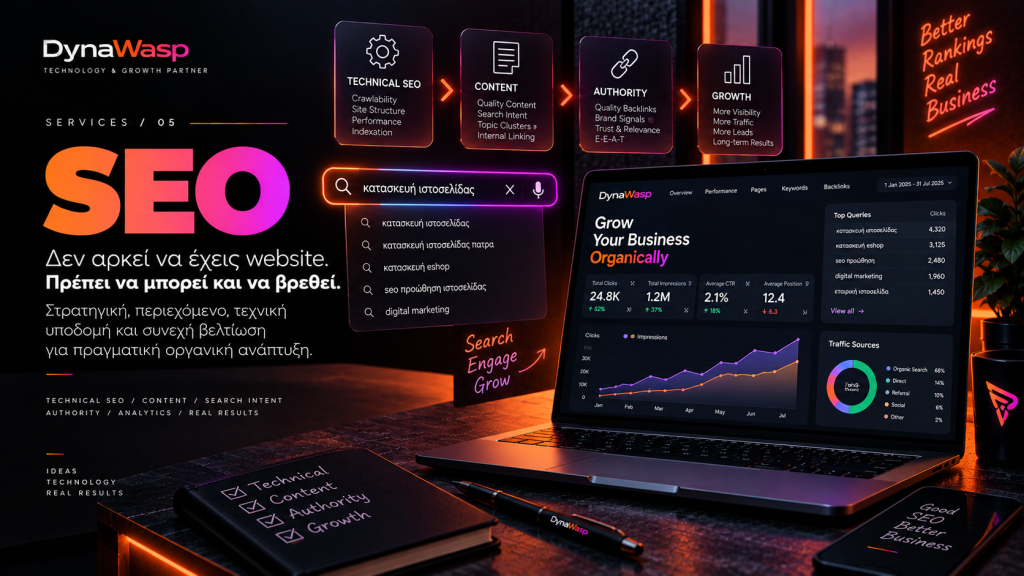
SEO — Having a website is not enough. It also needs to be found.
A business can have an excellent website. Modern design. Fast loading. The right services. A good product.
But if the people searching for what it offers cannot find it, a significant part of the website’s potential remains untapped.
This is where SEO — Search Engine Optimisation — comes in. And despite its name, modern SEO is not simply about “optimising for a search engine”. It is about creating a digital environment that helps both search engines and people understand who you are, what you offer and why your content deserves to appear for a specific search.
1. SEO does not mean “adding keywords”
For many years, the conversation around SEO was limited to keywords. Keywords obviously still matter. But repeating a word dozens of times on a single page is not a strategy.
What matters most is understanding what the user is really looking for. Searches such as “e-shop development”, “e-shop development cost” and “WooCommerce or Shopify” relate to the same general topic, but they do not express exactly the same need.
2. Search intent: why was the search made?
Behind every search query there is an intention. Someone may want to learn, compare, buy, find a specific company or solve a problem. This is search intent.
We do not only ask “Which keyword do we want?”. We ask: “What does the person typing it expect to find?”
3. Technical SEO starts with how the website is built
A website needs to be discoverable, crawlable and correctly understood by search engines. The technical foundation may include a sound URL structure, HTTPS, a sitemap, robots directives, canonical URLs, redirects, correct use of status codes, mobile compatibility, structured data where appropriate, indexation checks and proper internal linking.
If the technical infrastructure has serious problems, even excellent content may struggle to reach its full potential.
4. Site architecture: structure matters
A website’s architecture is not just about the menu. It is about how information is organised. A logical structure helps users navigate and helps search engines understand the relationships between pages. The larger a website grows, the more important this architecture becomes.
5. On-page SEO: every page needs a clear purpose
A well-structured page should clearly explain its subject. Title, H1, headings, copy, images, internal links and metadata should all work together. Not to “trick” an algorithm, but so that the content is organised, understandable and useful.
6. Content should answer real questions
A blog does not need articles purely so that something gets published every week. It needs content that has a reason to exist.
What do customers ask before they buy? What do they not understand? What are they comparing? What problems are they facing? What decisions are they trying to make? These questions can be turned into genuinely useful content.
7. Topic authority: not one article about everything
If a company wants to build an organic presence around a specific field, a single article is usually not enough. It needs to develop an ecosystem of related content.
We are not trying to talk about everything. We are trying to prove that we know, in depth, the topics that are genuinely related to what we do.
8. Internal linking: pages need to talk to each other
An article should not be an isolated island. Related articles and services should link to each other logically. This creates pathways for visitors and for search engines, helping to make it clearer which content is related.
9. Performance and SEO meet in the experience
A slow website is not a good experience, especially on mobile. Technical optimisation may include proper image optimisation, caching, reducing unnecessary scripts, suitable hosting, a CDN where needed, CSS/JavaScript optimisation and monitoring Core Web Vitals.
Performance is UX, development and SEO all at once.
10. SEO for e-commerce: a different level of complexity
An e-shop can have hundreds or thousands of URLs: products, categories, variations, filters, pagination and out-of-stock products. This is where challenges such as duplicate content, cannibalisation, indexation of useless URLs, poor category structure and products without meaningful descriptions come into play.
E-commerce SEO requires a combination of commercial strategy, content and a technical understanding of the platform.
11. Local SEO: when the customer is searching nearby
For many businesses, the most important search is local. The business’s overall local presence, the consistency of its details, relevant landing pages where they genuinely make sense, and reviews can all be important elements of the strategy.
Local SEO does not mean creating dozens of near-identical pages that only change the name of a town. It requires genuine local relevance.
12. Authority and backlinks
Search engines do not only look at what a website says about itself. Its presence and mentions across the wider web can matter too.
A genuine editorial mention from a relevant, trustworthy website is very different from hundreds of artificial, low-quality links. Quality, relevance and naturalness are worth more than a large number of dubious links.
13. SEO and AI search
The way people find information is evolving. Search is no longer limited exclusively to the classic list of results. AI-powered search experiences and conversational interfaces can present information in different ways.
Clear structure, specific answers, trustworthy content, sound technical infrastructure and a clear business identity remain essential.
14. SEO does not guarantee first place
No one controls a search engine’s organic results. Algorithms change, competitors improve and the market evolves.
A serious SEO strategy should not be built on promises like “We’ll get you to number one on Google”. What we can do is improve the foundations, the content, the technical health and the authority, and increase the chances of organic growth. SEO is not a button.
15. SEO takes time
Paid advertising can start bringing in traffic very quickly. SEO works differently. It involves crawling, indexing, content, authority, competition and continuous improvement.
That is why it should be treated more as an investment in a digital asset and less as a short-term campaign.
16. We are not simply interested in more traffic
10,000 visitors who are not interested in our service are not necessarily better than 500 people with genuine intent. That is why we need to look beyond rankings and clicks: organic leads, sales, qualified traffic, conversions and revenue, where it can be properly attributed.
Success means bringing the right audience closer to the business.
So, what is SEO?
SEO is not a plugin. It is not a list of keywords. It is not four articles a month. And it is not a promise that tomorrow we will appear first.
It is a combination of technology, content, strategy, authority, user experience and data.
When these work together, a business’s organic presence can become a digital asset that keeps creating value over time.
Frequently Asked Questions
How long does SEO take to deliver results?
There is no set timeframe that applies to every website. It depends on the state of the domain, the competition, the market, technical issues, existing content and the strategy being applied.
Can anyone guarantee first place on Google?
There is no reliable way for anyone to guarantee a specific organic position, as results are determined by systems that the SEO agency does not control and that change constantly.
Does a new website need SEO?
It is particularly valuable for the technical foundation and content structure to take SEO into account from the build stage. It is easier to create the right architecture from the start than to fix fundamental structural problems later.
SEO or Google Ads?
They are not necessarily competing strategies. Ads can deliver immediate paid visibility, while SEO aims at the long-term growth of an organic presence. Depending on the objective, they can complement each other.
The DynaWasp approach
At DynaWasp, we do not treat SEO as an isolated service that begins once the website is complete. Development, performance, UI/UX, content and SEO all influence one another.
That is why we start with the technical foundation and structure, examine what the audience is really searching for and create content that has a reason to exist. Not content to fill a blog. Content that answers, informs and can bring the right person closer to the business.
Want to find out what is holding back your website’s organic growth today? Talk to the DynaWasp team so we can review the technical health, the content and the real opportunities for organic growth.