


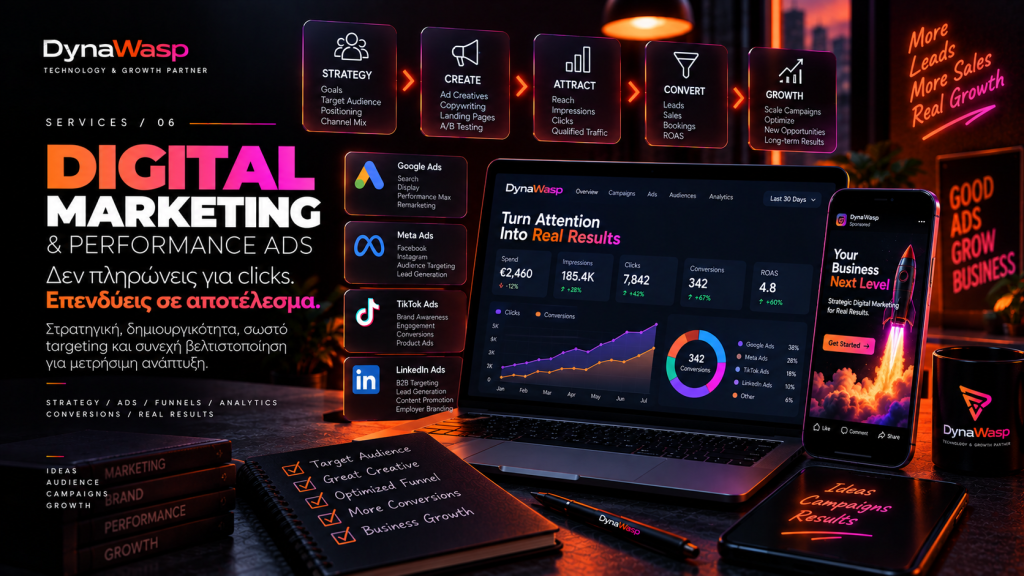
“We ran ads, but they didn’t work.” It is a phrase we hear often.
But what exactly does it mean for an ad to have “worked”? Did it bring clicks? Visits? Followers? Leads? Sales? And ultimately, do the sales it generated justify the money that was spent?
Digital marketing should not start with the “Create Campaign” button. It should start with the business objective.
1. Before the ad comes the objective
You cannot design the right campaign without knowing what you want to achieve. Awareness is one objective, leads another, e-shop sales another, bookings another and winning back former customers yet another.
Each objective requires a different message, a different audience, a different funnel and a different way of measuring success.
“I want more advertising” is not a strategy. “I want more qualified leads at a sustainable acquisition cost” is much closer to a real business objective.
2. Not all clicks are equal
A campaign can show excellent numbers: thousands of impressions, hundreds of clicks, a low CPC. But if none of those people take the action that actually matters to the business, clicks alone are not enough.
That is why we need to separate platform metrics from business metrics. A low cost per click is only positive when the traffic we are buying has a genuine chance of leading to our objective.
3. The funnel starts before the conversion
People are rarely all ready to buy the moment they see an ad. Some may be seeing the brand for the first time, some already understand their problem but are weighing up options, some are comparing companies and some are ready to get in touch.
The right message therefore depends on where the user is in the funnel. We do not always ask for a sale at the first point of contact.
4. Google Ads and social ads do not do exactly the same job
A user searching Google for “e-shop development company” has already expressed an intention. On social media the situation is different: the user may not be looking for our service at that moment.
That is why search advertising and social advertising require different creative and strategic approaches. No single platform is “better” for everyone. There is the platform that best fits the specific objective and the specific audience.
5. Creative is part of performance
The technical set-up of a campaign matters. But first, the ad has to capture the attention of a real person.
Visual, video, headline, hook, copy, offer and call-to-action all affect the result. A well-configured campaign with weak creative can fail. And excellent creative aimed at the wrong audience can fail too.
Performance comes from the combination.
6. The offer matters more than we think
Sometimes we try to fix a campaign by changing audiences, placements and bidding, when the real problem is that the offer is not attractive or clear enough.
Why should someone get in touch now? What exactly will they get? What problem are we solving? Why should they choose us?
Advertising cannot fix a weak value proposition on its own. It can simply show it to more people.
7. The landing page is part of the ad
A campaign does not end when the user clicks. In reality, that is where the most important part begins.
If the ad promises one thing and the landing page presents something different, the experience breaks. If the page is slow, difficult to use or full of irrelevant information, we lose people we have already paid for.
A good landing page should continue the same story as the ad: the same message, a clear value proposition, relevant content, a visible CTA and as little unnecessary friction as possible.
8. Tracking: if we don’t measure correctly, we optimise blindly
To evaluate a campaign, we need to know what happens after the click: form submissions, purchases, calls, bookings, add-to-carts, qualified leads and other important actions.
Setting up analytics and conversion tracking correctly is a core part of the process. And as privacy and consent requirements evolve, the way data is collected and used must also be designed with care.
The wrong data can lead to the wrong decisions.
9. ROAS is not the only metric
In e-commerce we often come across ROAS — Return on Ad Spend. If we spend €1,000 and €4,000 in revenue is attributed, we can calculate a ROAS of 4.
But that does not automatically mean the campaign is profitable. There are product costs, shipping, returns, fees, discounts, operating expenses and profit margins to consider.
Revenue is not profit.
10. CAC and Customer Lifetime Value
How much does it cost us to acquire a new customer? That is the Customer Acquisition Cost — CAC.
But there is a second question: how much value can that customer create over time? That brings us to Customer Lifetime Value — LTV.
That is why marketing performance should not always be judged on the first transaction alone.
11. Remarketing: the second chance
Someone visited the website, viewed a product, read about a service or perhaps added something to their basket, but did not complete the action. That does not necessarily mean they are not interested.
Where permitted, and when implemented in line with privacy and consent requirements, remarketing can put the brand back in front of people who have already interacted with it. But it needs to be used in moderation.
12. A/B testing: assumptions need to be tested
Which headline works better? Which visual? Which offer? Which landing page?
We can have an opinion. But when there is enough traffic and a sound methodology, we can also test it. Testing allows strategy to evolve on the basis of data, not just personal preference.
13. Budget should not be split at random
Spreading a small budget too thinly can prevent every campaign from gathering enough data.
Budget should follow the objective, the size of the audience, the value of a conversion, performance and the business’s ability to meet demand. There is no “right daily budget” that applies to everyone.
14. Scaling does not simply mean “putting more money in”
A campaign performs at €1,000. That does not mean it will perform in the same way at €10,000.
As spend increases, you may need to broaden the audience, frequency may rise, creatives may need to change or saturation may set in.
The goal is not simply to spend more. It is to increase investment for as long as the financial return remains sensible.
15. Marketing and sales need to talk to each other
In a service business, marketing may bring in dozens of leads. But what happens next? How many were genuinely suitable? How many received a quick response? How many became meetings? How many turned into proposals? How many were closed?
CRM, lead statuses and feedback from sales can help marketing optimise towards better-quality leads, not simply more leads.
16. Performance marketing is an ongoing process
Campaign launch. Data. Analysis. Hypothesis. Test. Optimisation. New data. And back to the start.
There is no “perfect campaign” that is set up once and works forever. Creatives, competition, audiences, platforms and the business itself all change.
Continuous optimisation is part of marketing. Not a sign that something went wrong.
So, what is performance marketing?
It is not buying clicks. It is not pressing Boost Post. It is not looking only at impressions and followers.
It is the effort to connect: Budget → Audience → Message → Experience → Conversion → Business Result.
And to be able to measure, as far as possible, what happened between each of these stages.
Because in the end, the most important question is not “How many clicks did we get?”. It is: “What result did this investment create for the business?”
Frequently Asked Questions
Google Ads or Meta Ads?
It depends on the product, the service, the audience and the objective. Google can be particularly useful when there is already active search intent, while social platforms can help with discovery, visibility and generating demand. Many strategies use both together.
How much budget does an advertising campaign need?
There is no single amount that suits every business. It depends on the market, the competition, the objective, the value of a conversion and how much data is needed for a meaningful evaluation.
When will I see results?
Paid campaigns can generate traffic immediately, but evaluating real performance requires data. The timeframe depends on volume, budget, the conversion cycle and the campaign’s objective.
Do I need a landing page?
Not in every case. But when a campaign has a specific offer or objective, a dedicated landing page can create a more consistent experience than sending all traffic to the homepage.
The DynaWasp approach
At DynaWasp, we do not look at advertising in isolation from the rest of the digital ecosystem. Creative influences the click. The website influences the conversion. UI/UX influences the experience. Tracking influences decisions. CRM and sales show us whether a lead had real value.
That is why we look at the journey as a whole. From the first time the ad appears to the real business result.
Already running campaigns but not clear on what they are really delivering for you? Talk to the DynaWasp team so we can review your tracking, campaigns, funnel and the points where performance is being lost.